
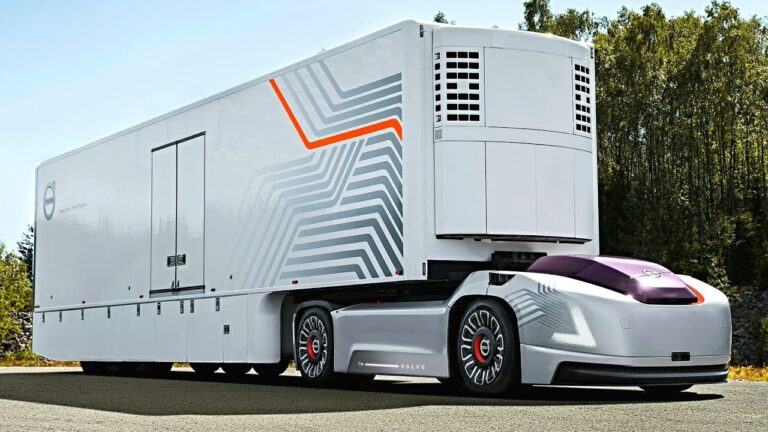
The news of self-driving or automated trucks in development and testing is popping in the newsfeeds more and more often. Is this good or bad for the industry?
L4 autonomous refrigerated truck has completed its trial run from Tulare, CA, to Quakertown, PA just before Thanksgiving 2019. The truck transported a full load of Land O’ Lakes butter.
The trip took less than three days. It did have a team consisting of a driver and an engineer onboard, but they never had to take over. In fact, the trip took 3 days only because the team had to take the regulated breaks. The technology that made this trip possible was developed by Plus.ai.
This 3-day journey is an important milestone. Plus.ai has been running short experimental trips to test its SLAM system. The goal of the 3-day run, though was to put the system through the 3-day stress in varying weather conditions – from snow to rain, as well as day to night. This was an important breakthrough that makes us think about the possible changes in the industry.
Understanding how autonomous Self-Driving technology works
Autonomous vehicles rely on sensors able to detect distances to objects, signals, and complex software capable of analyzing this information. The software interprets this information. Based on this interpretation the vehicle’s actuators take action: to accelerate, brake, change lanes, or turn. Self-learning modules play an important role to adapt to the road and weather conditions.
There are 5 levels of vehicle automation from 0 (no automation ) to 5 (full automation) not requiring operator’s or driver’s intervention. International companies like Navya, Waymo, Magna, Volvo, and Baidu are working on the improvement of car automation systems.
While most of the regular consumer vehicles can claim only cruise control as the only feature close to automation, test self-driving cars started to appear in limited areas.
Most of the vehicles that are involved in ride-sharing are level 3-4 automation, which now gives us significant data to see and analyze the challenges.
There are limitations – they are used in urban environments, only for short distances and short periods of time.
Even at this level, there were some recurring safety issues that pulled back the use of test robo-cars by Uber. The software did not have consideration for erratic jaywalking pedestrian behavior. The fatal crash caused by a self-driving Uber car in 2018 in Arizona, blamed on faulty software had a big fallout effect. Over the period of 18 months, the company’s autonomous vehicles were involved in 37 crashes.
Autonomous Vehicles Dilemmas
Any type of vehicle is much more than its mechanical, and soon quite possibly, automated parts and features. It serves its purposes in our society and economy. It also must do it safely. The unanswered questions will mean someone’s life.
Fast-changing traffic conditions
Urban traffic is hectic, the road is full of fast-moving unpredictable objects. Not all traffic participants obey the traffic rules. There are cars speeding, bicycles brushing by, and possibly can of paint thrown from overpass on the highway below.
It is true that not every driver can react fast enough to avoid collision in these circumstances. While we eventually can trust engineers to create perfect software for imperfect life, it will take a while.
The human factor
The pedestrian standing on the curb and gaging the speed of traffic. To run across the road or not? While for sensors, radars, and cameras it is just an object, a driver sees his or her facial expression and makes the decision to break in split seconds…
Will the software be ever ready to anticipate that move? Will it be ready for a reversing car in the middle of traffic? We are human, we are known to do illogical things. We even might not be up to artificial intelligence’s standards.
As clear and day and night
Light changes through the day – making it difficult for sensors to see. It caused a lot of problems in early self-driving test cars. The car driving directly into the sunset? A sun caught in the skyscraper window blinds the sensor? Someone plays a cruel joke with a laser pointer? What seems to be a tricky but simple situation for a driver might make electronics throw a dangerous tantrum.
Cybersecurity challenge
Perfecting analyzing algorithms is a matter of time and with some challenges looks like a doable task. But the self-driving cars pose a serious threat unexpectedly from the cybersecurity angle.
Blame it on the weather!
Lane lines covered with snow? Black ice? Dirt splattered on the sensor. Fog – making objects invisible? As we see until now, most driverless tests are taking place in sunny and dry Arizona and California. Will the smart sensors ever be in their element in Minnesota, or here, in Canada?
Should self-driving vehicles have dedicated lanes or be a part of regular traffic?
We all expect the machines to be efficient, choose the optimal route, go at an optimal pace. And the test self-driving cars are almost perfect at it. The trouble is the rest of the traffic isn’t. Dedicated lanes do seem like a great idea, but most cities just don’t have enough room for that anymore… Won’t mixing in our erratic driving style with the perfect driving style of the robots cause more problems?
Let’s pop a liability question!
In case of an accident caused by a fully automated car – who is at fault? The engineer, the designer? The manufacturer? We are pretty sure the simple problems will be solved before the launch stage, leaving us with complex ones. In the case of the very first victim of automated car-created collision Elaine Herzberg, an undisclosed private settlement was reached, thus failing to create a legal precedent.
The benefits of autonomous long haul trucks
On paper, the benefits of self-driving fully automated trucks are too hard not to see:
- Efficient transportation
- Effective use of fuel due to accurate calculations and ability to maintain a constant speed on the road
- Elimination of accidents caused by fatigue (around 8000 accidents in the USA only) and human error
- No need for rest breaks and stops
But along with the points that are obvious there are still more questions than answers:
- How much will self-driving trucks will cost? (will they be affordable for private operators or large corporations?)
- Return on Investment for owners.
- Will they require a driver/engineer onboard, or a remote supervisor/operator? The tests have already shown that with high vehicle efficiency in case of emergency the human operator is rarely reacting fast, as their reactions are blunted with long inactivity.
- What changes to infrastructure will be necessary
- Will they require a last-mile driver for loading/unloading?
- The introduction of fully automated trucks is expected to change the service with the focus on electronics, programming, and more frequent scheduled maintenance. The routine truck service is expected to go up in cost.
- Change of distribution centers/major hubs geography. The current locations are tied to the truck driver schedule with regulated hours for sleep and rest. With self-driving trucks, it will be no longer a constraint.
- Will self-driving trucks be more vulnerable to theft and vandalism?
- The legislation base has to be ready both on the federal, state, and provincial levels.
When will the industry switch to autonomous trucks?
While a lot of technology components seem to be in place, we are still, most likely, decades away from seeing fully autonomous long-haul trucks on the highways. Along with developing the necessary technology, the autonomous trucks will have to be profitable enough and the new infrastructure, as well as legislation, has to be in place for this change.
XAN Logistics
We XL in temperature controlled transportation
